
Platano
Professional
Games eXtended
for Unreal Engine 5
Unreal projects rebuild the same systems.
PGX ships them once. Select plugins per project.
Settings hidden in C++ constructors, Blueprint defaults, multiple places. No single source of truth.
Every project rebuilds save, loading, audio, game flow from scratch. Hundreds of hours before your game begins.
Removing one feature breaks three others. No clean boundaries, no module isolation.
Systems demand deep understanding before usage. The framework fights you before it helps.
Config in constructors. Logic rebuilt per project. Features coupled.
Enable the plugin. Fill the DataAsset. Use it from C++ or Blueprints.
Save, load, audio, flow. Ready before your game code.
You enable a plugin. You fill a DataAsset. The system runs in C++ and Blueprints.
PGX is free and open source under the Apache License 2.0 — full source, no tier, no revenue share. The published v0.1.1 snapshot (Unreal Engine 5.7.4, Development Preview) includes 26 plugins, 48 modules, and full documentation.
Learn architecture patterns with real code.
Skip months of boilerplate. Ship faster.
Consistent codebase, modular plugins, zero coupling.
Extend via inheritance. Full source, no black boxes.
PGXDemo: press E, the state changes, the counter saves. Restart, the value persists. Open the Save Inspector and watch it happen.
Configure, run, inspect. The Hub shows every system. The Save Inspector shows domains, keys, and history.
Set values in a DataAsset. Play. Open the inspector to see what happened and why.
Editor Tooling →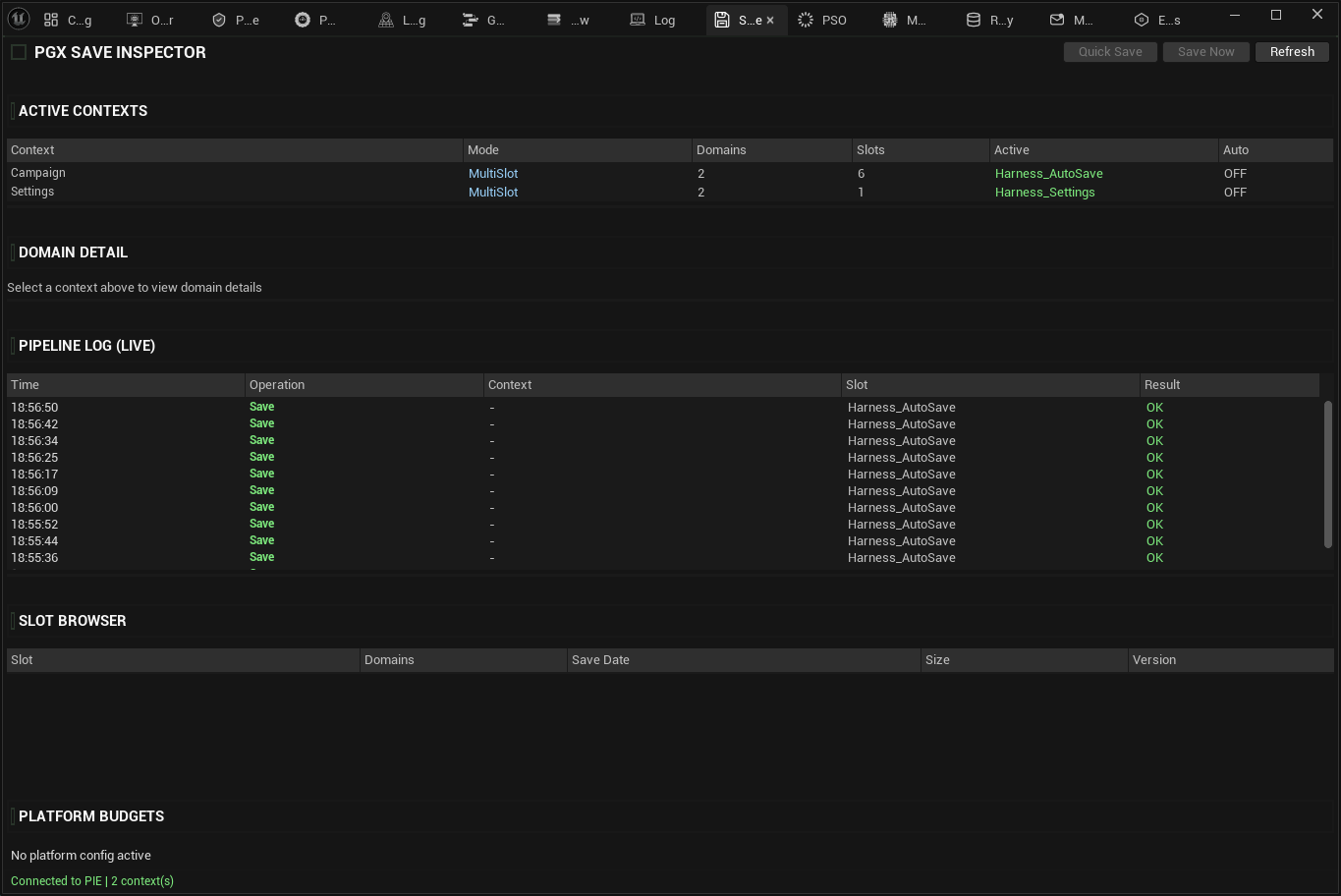
As of v0.1.1 (UE 5.7.4, Development Preview) — Windows Development targets. Automated checks: 242 editor + 115 game + 3 PGXDemo. Zero dependency cycles. Removing a system removes its service.
Every future framework builds on the same validated core.
PGX enforces a strict star topology: every L2 plugin depends exclusively on PGXCoreRuntime. No L2-to-L2 runtime dependencies -- ever.
Cross-plugin communication happens through two dedicated buses: UPGXMessageSubsystem (pub/sub) and UPGXEventHandlerSubsystem (behavior resolution).
This architecture guarantees that any plugin can be added or removed without breaking the rest of the framework.
PGX is being developed transparently. What you see is real, working software.
26 plugins across four maturity levels, validated on UE 5.7.4. Real code, real validation gates, real functionality.
Next authoring surface. Aligned with Epic's direction. No Verse runtime in v0.1.1. Roadmap.
Video walkthroughs, playable demos, and real screenshots as each framework matures.
v0.1.1 is a Development Preview: open for architecture and API review, things may break, not recommended for production. Each of the 26 plugins sits at one of four maturity levels.
PGXCore — the shared core every plugin depends on.
PGXAudio, PGXGameFlow, PGXLoading, PGXMGOS, PGXPSO, PGXSave.
PGXAbility, PGXCrafting, PGXInput, PGXInteraction, PGXInventory, PGXSpawn, PGXTrade.
PGXAI, PGXCamera, PGXColony, PGXEnvironment, PGXUI, PGXVehicles — state and schemas first, core behavior still incomplete.
PGXDocs, PGXEditorTools, PGXScaffold, PGXSimHarness, PGXTutorials, PGXVersionControl.
UE 5.7.4, Windows Development: editor 792/792, game 414/414, automation 242/242 editor + 115/115 game, PGXDemo 3/3, zero sanitizer and secret findings, zero dependency cycles. Not verified: packaged targets, other platforms, other engine versions, arbitrary plugin subsets.
The PGXDemo sample exercises Message, GameFlow, Save and InputBuffer. The other 22 plugins are covered by dependency and linkage, not as runtime demos.
v0.1.1 is C++ and Blueprints over DataAssets. Same flow. Verse comes next.
Enable the plugin. Fill the DataAsset. Call the API. In v0.1.1.
Same DataAsset. Same flow. Blueprint libraries. In v0.1.1.
Next authoring surface. Aligned with Epic's direction. No Verse runtime in this snapshot. No date. Not in v0.1.1.
PGX grows with our game development academy. Same tools in class and in production.
PGX Core is the horizontal foundation. Vertical frameworks extend it for specific genres and use cases.
The Horizontal Foundation — Shared by Every Framework
26 plugins across four maturity levels, star topology architecture. The base platform that every future vertical framework builds on.
Explore Core →Interactive Architectural Visualization
Real-time walkthroughs, material systems, lighting control, and VR support for architectural projects.
Explore →Third-Person Action RPG Kit
Combat, inventory, quest tracking, character progression, and open-world exploration systems.
Explore →Turn-Based Strategy Toolkit
Grid-based gameplay, unit management, AI opponents, campaigns, and skill trees.
Explore →First-Person Shooter Framework
Weapon systems, recoil patterns, hit detection, multiplayer support, and competitive features.
Explore →Physics-Based Puzzle Toolkit
Portal mechanics, mechanism chains, time manipulation, and interactive puzzle design.
Explore →Stealth Gameplay Systems
Detection AI, patrol routes, sound propagation, light/shadow mechanics, and disguise systems.
Explore →Horror Atmosphere Engine
Dynamic tension, adaptive lighting, AI stalker behavior, sound design, and sanity mechanics.
Explore →Quantum Physics Mechanics
Superposition, entanglement, wave function collapse, quantum tunneling.
Explore →Advanced Developer Productivity
Git workflows, advanced material management, automation pipelines, and editor extensions for professional teams.
Explore →